My Favourite Places: Jells Park, Wheelers Hill
There's something about an early morning that strips everything back. No noise, no rush — just you, the cold air, and whatever the day decides to offer. Jells Park in Wheelers Hill is where I go when I need that reset.
I've walked the path around the lake more times than I can count, and it never feels the same twice. That's the thing about this place — it looks ordinary on a map, but show up before the rest of the suburb wakes up, and it reveals itself completely differently. This page is where I keep my favourite Jells Park photos, from misty mornings on the lake to the birds that make the place what it is.

Jells Park in Photos
These are the photos I keep coming back to. All of them were taken on early morning walks around the lake, most within the first hour after sunrise.


The Walk Around the Lake
The loop around the lake is my go-to. It's unhurried, familiar, and endlessly rewarding if you're paying attention. In the early morning, the path is quiet — just the crunch of gravel underfoot and the occasional rustle from the reeds.
I always slow down at the water's edge. There's no point rushing through Jells Park. The whole point is to let it come to you.


Mist on the Water
On the right winter morning, the lake disappears into itself. A low mist sits over the surface, softening everything — the far bank, the trees, the birds moving through it. It's one of those scenes that makes you stop mid-stride.
I've tried to photograph it many times. Sometimes I get it right. More often, I just stand there and watch, which is probably the better outcome anyway. There's a stillness to a misty morning at Jells Park that's genuinely hard to describe — you have to be there for it.

The Birds of Jells Park
The lake is the reason I come, but the birds are the reason I stay. These are the ones I photograph most often.
The Ducks
The ducks are everywhere, and I mean that affectionately. On the lake, on the grass, waddling across the path with complete indifference to whoever's walking by. Pacific black ducks, wood ducks, the occasional teal — they go about their business with a confidence that I find quietly admirable.
On the green near the water's edge, you'll often find a whole congregation of them, heads down, grazing. It's an easy scene to walk past without a second glance. But get low, shoot into the light, and suddenly it's something else entirely. A year of them is in my Ducks wall calendar.
Purple Swamphens on the Ground
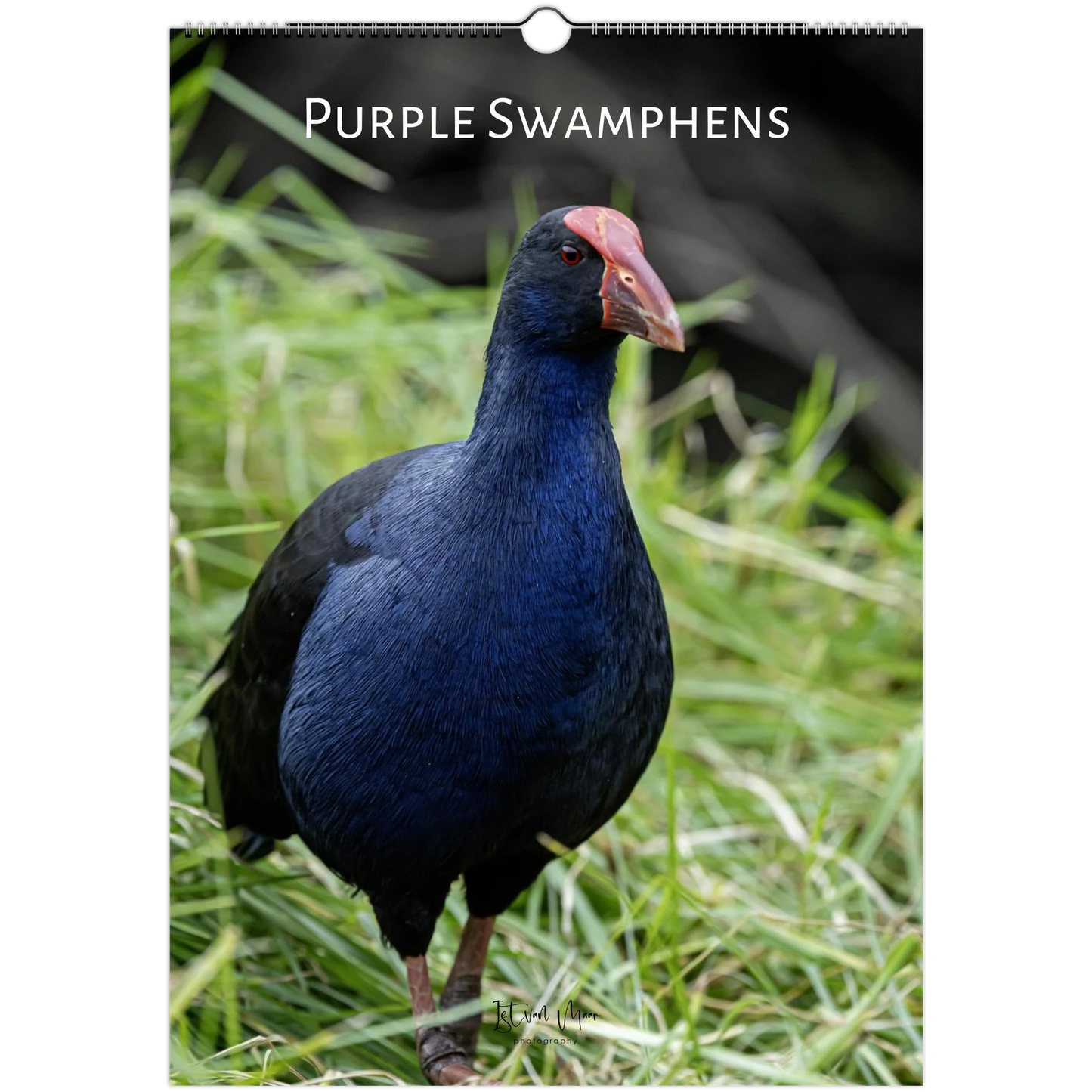
The purple swamphens are one of my favourite subjects at Jells Park — and they're remarkably unbothered. Unlike a lot of waterbirds that flush the moment you get within twenty metres, the swamphens tend to hold their ground. They'll look at you, assess the situation, and generally decide you're not worth the effort of moving.

That confidence makes them wonderful to photograph. The deep blue-purple of their plumage catches beautifully in soft morning light, and their bright red bills are almost absurdly vivid against the green grass. I've spent entire mornings just watching them work their way along the bank. Some of my favourite swamphen photos from these walks ended up in my Purple Swamphens wall calendar.
The Ibises on the Island
And then there are the ibises. If the swamphens are the quiet locals, the ibises are the loud neighbours who've never once considered turning it down.

There's a small island on the lake that they've claimed as their own, and on certain mornings the noise coming from it is extraordinary — a chaotic, overlapping chorus of calls that carries right across the water. Watch them lift off as a group and it's genuinely dramatic: a mass of white wings against the sky, circling, calling, completely unbothered by any sense of decorum.

They're not everyone's favourite bird. But there's an energy to them that I find hard not to love. Love them or not, the ibis colony on the island is impossible to ignore. I've photographed them here so often that they got a calendar of their own: the Bin Chicken wall calendar.
The Black Swans
After the ibises, the black swans feel like a different world. They don't call out or crowd the bank. They simply glide across the lake, slow and deliberate, as if the water belongs to them.

They're a gift to photograph. That red bill against black feathers needs very little help from me, and in the blue light of early morning the dark water turns them into something close to a silhouette. Some of my favourite Jells Park photos are of a single swan and its reflection, with nothing else in the frame. A few of them found their way into my Black Swans wall calendar. One of them is also on my Black Swan Tote Bag.
The Pelicans
Pelicans don't live at Jells Park the way the swamphens and ibises do. They drop in. Some mornings there are none, and on others a small group is sitting on the water as if they had always been there.
They are big, slow birds until something happens, and then everything happens at once. A pelican landing on the lake throws up more water than seems reasonable. Two of my favourite pelican photos from Jells Park ended up on tote bags: Splashing Pelican and Three Pelicans. More of them are in my Pelicans wall calendar.
The Eurasian Coots
The coots are easy to overlook. Small, black, with a white bill and a white shield on the forehead, they spend the morning working the edge of the lake while everyone looks at the swans.

I like them for exactly that reason. They are busy and a little bad-tempered with each other, and they give you plenty of chances if you stay in one spot. The best of my coot photos are in the Eurasian Coots wall calendar.
The Noisy Miners
You will hear the noisy miners before you see them. They work the trees along the path in small gangs, calling constantly and chasing off anything that comes too close, including birds several times their size.
They rarely sit still, which makes them harder to photograph than the waterbirds. The ones that did hold a pose for me are in the Noisy Miners wall calendar.
Take Jells Park Home
Many of the photos on this page became calendars and tote bags. If one of these birds is a favourite of yours, or of someone you know, this is where to find it:
- Calendars: Purple Swamphens, Bin Chicken, Black Swans, Pelicans, Eurasian Coots, Ducks, Noisy Miners
- Tote bags: Black Swan, Splashing Pelican, Three Pelicans
Why I Keep Coming Back
Jells Park isn't a destination in the way that some places are. It doesn't ask anything of you. You can walk the whole lake in under an hour, see nothing remarkable, and still leave feeling better than when you arrived.
But on the right morning — misty, still, with the swamphens on the bank and the ibises kicking up a racket on the island — it's as good as anywhere I've been with a camera. And it's fifteen minutes from home.
That's a rare thing. If you enjoy bird photography around Melbourne's parks, Braeside Park is another favourite of mine, and it's just as rewarding at first light.
Visiting Jells Park
Jells Park is in Wheelers Hill in Melbourne's south-east. Entry is free and the park is open all year.
There are several car parks. For the lap around the lake, come in from Jells Road: the entrance road takes you straight to the car park that is the best starting point for the lake path.
The best time to come is around sunrise. The birds are having their breakfast then, which makes them much easier to photograph: they are busy, they stay put, and the light is soft. The walk around the lake takes under an hour, though I rarely manage it that quickly with a camera.