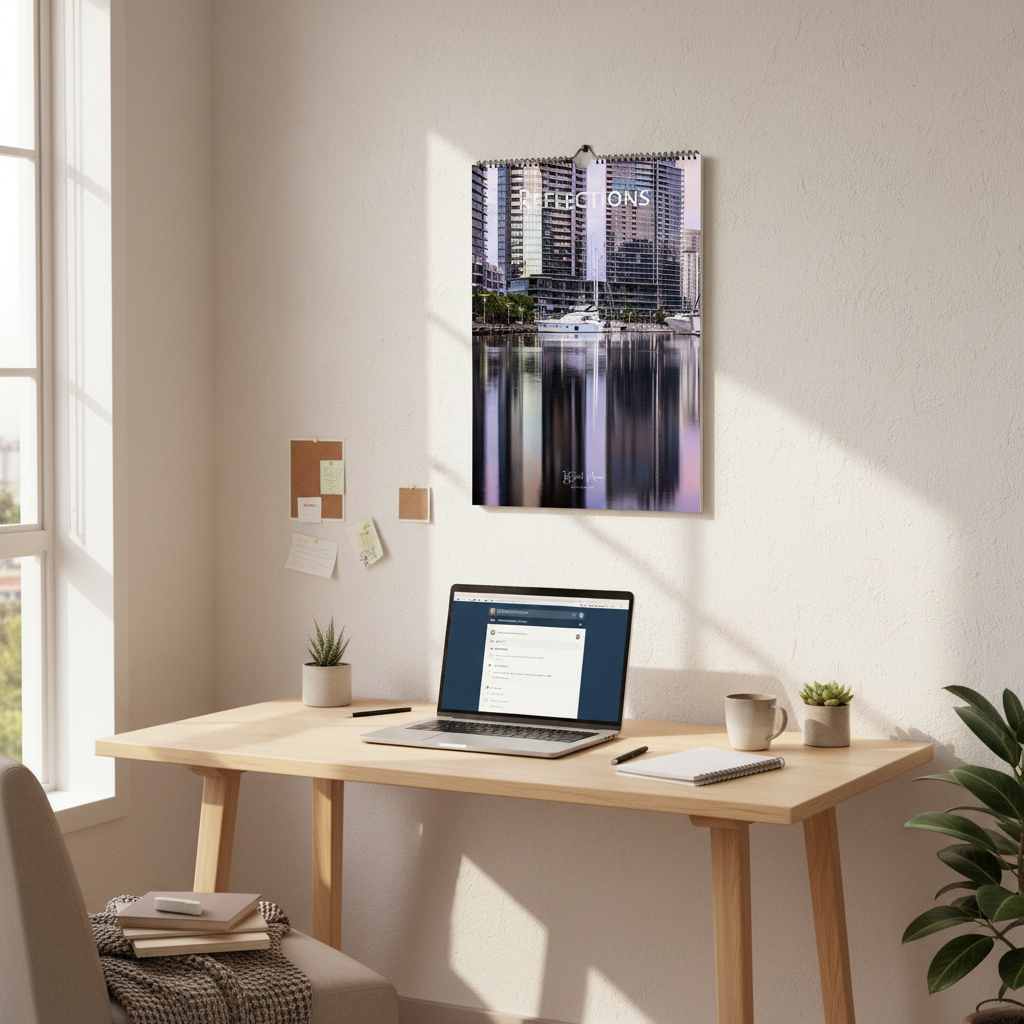
The Art of Reflection Photography: Why We Love It, and What It Takes to Capture It
Share
There's something about a reflection that stops people in their tracks. A mountain mirrored perfectly in a still lake, a city skyline doubled in a puddle after rain, a single tree repeated upside down in glassy water — it's one of the most reliably captivating subjects in photography, and I think it comes down to something deeper than just a nice symmetrical picture.
Why We're Drawn to Reflections
A reflection shows us the world twice — once as it is, and once as a quieter, softer echo of itself. There's something almost meditative about that duplication. It slows the eye down, inviting you to compare the real and the reflected, to notice the small differences between them, the way the water blurs or distorts what's above it.
Water itself carries a lot of symbolic weight — calm, stillness, reflection in the more thoughtful sense of the word too. A perfectly still lake at dawn doesn't just look peaceful, it feels peaceful, and a photograph that captures that stillness tends to carry that same sense of calm through to whoever's looking at it. I think that's a big part of why reflection photos resonate with people the way they do — they're not just visually striking, they evoke a mood.
The Complexity Behind a Simple-Looking Shot
Reflection photography looks effortless in the final image, but getting there is genuinely one of the more technically demanding types of shots I take. A few things have to line up at once:
Wind
The single biggest enemy of a good reflection is wind. Even the faintest breeze breaks up the surface of the water into tiny ripples, and a rippled surface scatters and distorts the reflection instead of mirroring it cleanly. This is why reflection photography so often happens at dawn — before the wind picks up for the day, the water is at its stillest.
Timing and Light
Beyond wind, the quality of light matters enormously. Soft, even light — the kind you get just after sunrise or just before sunset — tends to produce the richest, most balanced reflections, without the harsh highlights and blown-out skies you get from shooting straight into a midday sun. Overcast days can actually work beautifully too, since the flat light removes glare from the water's surface almost entirely.
Long Exposure
For water that isn't perfectly still, a long exposure can do a lot of the work that calm conditions would otherwise handle. By using a slower shutter speed — often with the help of a neutral density filter to avoid overexposing the shot — small ripples get smoothed out into a soft blur, which can restore a lot of the mirror-like quality that wind would otherwise ruin. It's a different kind of reflection to a perfectly still lake, but it has its own atmospheric quality, especially with moving clouds or flowing water.
Composition
Where you place the horizon matters more in reflection photography than almost any other genre. Centring it so the real and reflected halves are equal often creates the most striking symmetry, though sometimes giving more weight to the reflection itself — letting it dominate the frame — produces a more dreamlike, abstract result.
Why a Whole Calendar Deserved This Theme
Once I started actively chasing reflections — waiting out windy mornings for the right calm window, working with long exposures on less cooperative water — I realised how much variety was possible within a single idea. Architecture doubled in a harbour, mountains mirrored in alpine lakes, city lights smeared across wet pavement at night. Twelve very different reflections, each one shaped by getting the wind, the light, and the water exactly right.
You can see the results in the Reflections Wall Calendar, available here.