The Hidden Challenges of Photographing the Australian Coastline
Share
Coastal photography has a reputation for being relaxing — turn up, watch the waves, take a few shots. In practice, it's one of the more physically demanding and unpredictable types of photography I do, and the Australian coastline in particular has its own set of challenges that don't show up until you're actually out there with a camera and your boots full of sand.
The Sand Problem
Getting the shot often means walking a fair distance across soft, uneven sand, sometimes carrying a tripod, multiple lenses, and filters, all while trying to keep the gear clean. Sand gets into everything — tripod leg locks, lens mounts, camera bags left open for even a moment. A gust of wind at the wrong time can send a fine spray of sand straight across your sensor if you're not careful about changing lenses in the open. It sounds like a small thing until it costs you a repair bill.
Reading the Site and the Conditions
Australian beaches vary enormously, and each one comes with its own quirks. Some have firm, walkable sand right up to the shoreline; others are soft and exhausting the whole way down. Tide timing matters just as much — arrive at the wrong point in the tide cycle and a wide, photogenic stretch of sand can simply be underwater, or a rock platform you wanted to shoot from can be completely inaccessible.
Checking tide charts and swell forecasts before heading out isn't optional if you want a specific composition. I've turned up to locations at what should have been the perfect time, only to find the tide had come in further than expected and the shot simply wasn't there anymore.
Wind and Its Effect on Everything
Wind is a constant factor on the coast, and it affects far more than just comfort. A strong onshore wind churns up the water, kicks up sea spray that coats your lens, and makes a tripod genuinely difficult to keep steady for longer exposures. It also affects the wave patterns themselves — choppy, wind-blown water photographs very differently to the smoother, more rhythmic waves you get on a calmer day.
On the flip side, a still, low-wind morning is when the coast has the best chance of surprising you with something extra.
Reflections, If You're Lucky
On the calmest days, particularly around low tide when a thin sheet of water is left sitting on flat, wet sand, you can get genuinely beautiful reflections — clouds, cliffs, even a rising sun mirrored on the beach itself. It's not something you can plan for with certainty; it depends on the right combination of tide, wind, and sand conditions all lining up at once. When it happens, it's one of the most rewarding moments in coastal photography, and part of why I keep coming back to the same stretches of coastline again and again, hoping to catch it.
Why It's Worth the Effort
Between the sand, the tides, the wind, and the sheer physical effort of getting to some of these locations at the right time, coastal photography demands more preparation than people often assume. But that unpredictability is also exactly what makes it rewarding — no two mornings on the same stretch of coast ever look quite the same.
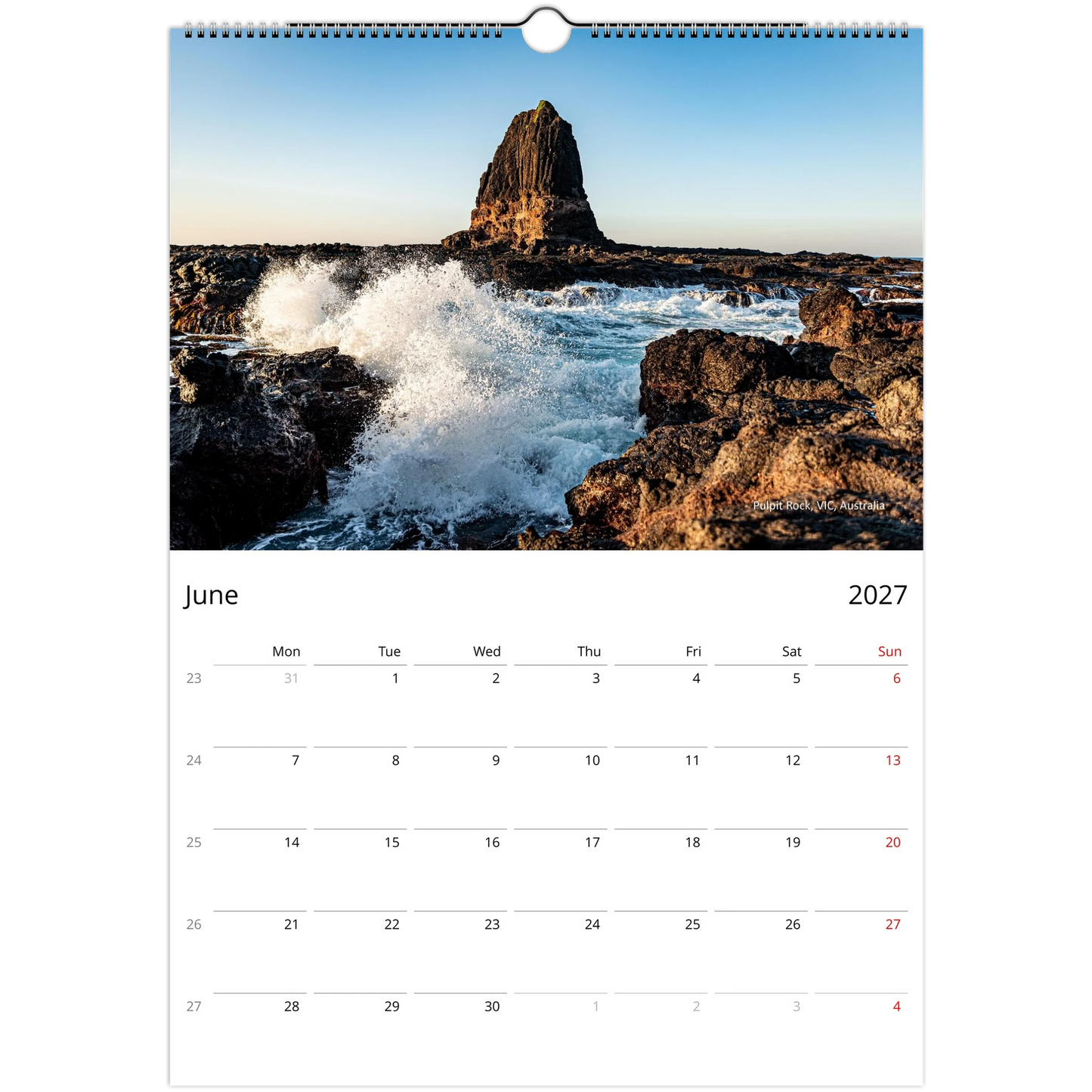
A full year's worth of that unpredictability is what became the Australian Coastal Wall Calendar, available below.