The Twelve Apostles and Gibson Steps: Seeing the Great Ocean Road's Giants from Above and Below
Share
If the Great Ocean Road has a postcard, this is it. The Twelve Apostles are the stop everyone has heard of, and on my February 2024 trip along the coast they were the place I was most curious to see with my own eyes. What surprised me is that there are really two very different ways to see them: from above, on the viewing platform, and from below, on the sand at the bottom of Gibson Steps.
This post is part of my Great Ocean Road series. If you'd like the story of the road itself first, start with The Great Ocean Road: The Story Behind Australia's Most Famous Coastal Drive.
A Few Facts About the Apostles
The name is a bit of a marketing trick. There were never twelve of them: the site originally had nine limestone stacks, and they were first known by much less glamorous names, including the Sow and Piglets. The Twelve Apostles name came later, to attract visitors.
The stacks are made of soft limestone that the Southern Ocean has been working on for millions of years. Waves carve caves into the cliffs, the caves become arches, the arches collapse, and what's left standing out in the water becomes a stack. Then the waves start on the stack.
Fewer Apostles Every Time You Visit
When we arrived in Australia in 2005, there were more Apostles standing than there are today. That same July, a stack around 50 metres tall collapsed into the sea, and another followed in 2009. Today seven are left, some of them still close to 50 metres tall.
And the count only goes one way. The same waves that shaped the stacks are still undercutting them, so sooner or later another one will fall. Meanwhile, the headlands along this coast are slowly being carved into the stacks of the future, but on a timescale none of us will ever see. If the Apostles are on your list, don't leave it too long: the view you see today won't be the view the next generation sees.
From Above: the Viewing Platform
The main view of the Apostles is from the clifftop viewing deck in Port Campbell National Park, a short walk from the visitor centre. From here you look along the coastline as the stacks step out into the sea, with the cliffs disappearing into the haze behind them. It's the classic view, and it really is as good as the photos.
One important change for anyone planning a trip: a brand-new visitor centre opens at the Twelve Apostles on 16 October 2026, and from that date, visits (including parking) need to be booked online through the official Twelve Apostles website. Entry is free until April 2027, after which a visitor fee is planned. Check the official site for current opening hours and booking details before you go, especially if you're planning a sunrise or sunset visit.
From Below: Gibson Steps
A little east of the Apostles, Gibson Steps take you from the clifftop down to the beach. There are 86 steps, carved into the cliff by local settler Hugh Gibson along a route the Kirrae Whurrong people of the Eastern Maar nation had used long before him. Gibson Steps has its own car park, and you can also reach it on foot along a section of the Great Ocean Walk from the Twelve Apostles.
At the bottom, the scale changes completely. From the viewing platform, the stacks look like neat sculptures arranged along the coast. On the sand, you're standing at their feet, with the cliffs towering behind you and the waves rolling in around you. The two huge stacks you see right off the beach are known as Gog and Magog. Strictly speaking, they aren't counted among the Twelve Apostles, but standing below them, nobody cares about the technicality.
Before You Go Down to the Beach
This beach is beautiful, but it isn't a sheltered swimming beach. It faces the full force of the Southern Ocean, and conditions can change quickly. A few things are worth taking seriously:
- Check the tide times and the swell before you go. Aim for low tide, and ideally a falling tide, so the water is moving away from you while you're on the sand.
- Read the signs at the top of the steps. Beach access can be closed or limited depending on the weather, tides and safety conditions.
- Watch the waves, not just the view. Big sets can run much further up the sand than the waves before them, and the water can reach right to the cliff line.
- Keep away from the base of the cliffs. The limestone here is constantly eroding, and rockfall is a real risk.
- Don't swim. The surf and currents here are dangerous.
- Leave yourself time to climb back up. The steps are steep, so don't leave it until the light has completely gone.
Photographing the Apostles
A few things I'd suggest, whether you're shooting from the deck or the sand:
- Time it with the light. Sunset is the classic time, when the low sun warms up the limestone and turns the sea gold. Sunrise is softer and usually much quieter. Midday light is the hardest, flat and harsh, and it's also when the crowds are biggest.
- Stay for blue hour. Once the sun has gone, the sky and sea turn deep blue while the stacks keep a little warmth. It's a different mood entirely, and many people have already left.
- Bring a tripod. In low light you'll need it, and a long exposure of a few seconds turns the restless water around the stacks into soft mist.
- Use two lenses. A wide angle captures the whole sweep of the coast from the platform. A longer lens lets you pick out a single stack and compress it against the cliffs behind, which often makes a stronger picture.
- On the beach, get low. A low angle makes Gog and Magog feel even more massive, and wet sand after a retreating wave gives you a mirror for reflections.
- Protect your gear. Salt spray hangs in the air here, so bring a cloth and wipe your lens often. On the sand, keep your bag well above the reach of the waves.
- Check the rules before flying a drone. Drone use in Victorian national parks is restricted, so check Parks Victoria's current rules first.
Take the Coast Home
See every month in 36 seconds:
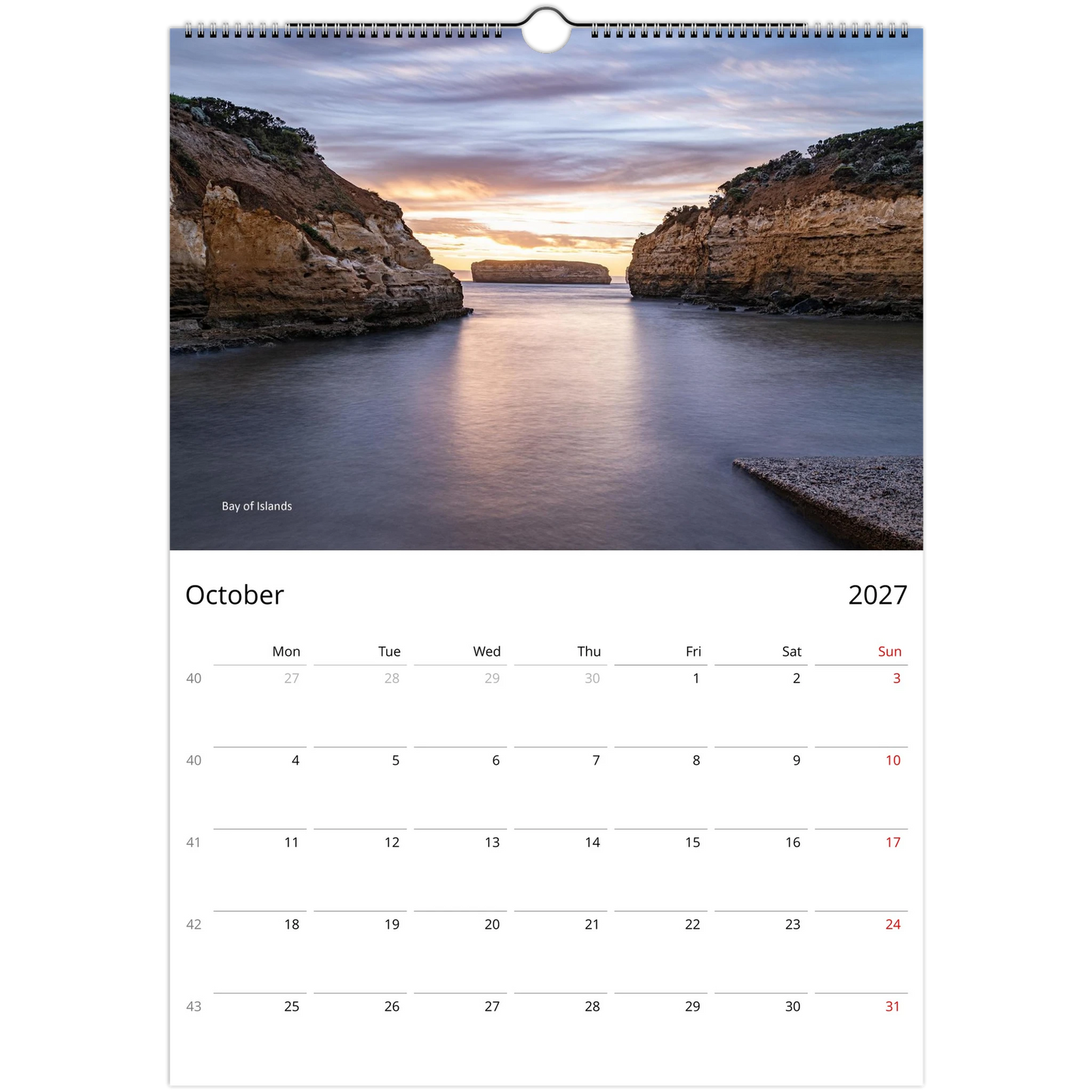
The view from the bottom of Gibson Steps became one of my panorama canvases, the Great Ocean Road Coastal Panorama. For a year of this coastline on your wall, the Great Ocean Road Wall Calendar is personalised to order.
Next in the series: more of the Shipwreck Coast, including the Bay of Islands and the Grotto.